glowgreen
Introduction
glowgreen is a Python package for calculating the radiation dose received by an individual
who shares a pattern of close contact with a radioactive person.
Two kinds of contact patterns are supported: onceoff patterns and infinitely repeating diurnal patterns.
The dose from the contact pattern can be calculated taking into account a period of delay
from the time of administration of the radioactive substance to when the contact pattern is started or resumed.
A method is also provided to calculate the shortest delay required to satisfy a given dose constraint,
referred to as the restriction period.
The clearance of radioactivity from the patient can be modelled as either exponential or biexponential.
Installation
Install the package from the Python Package Index (PyPI) using pip:
python -m pip install glowgreen
Example usage
Define a contact pattern
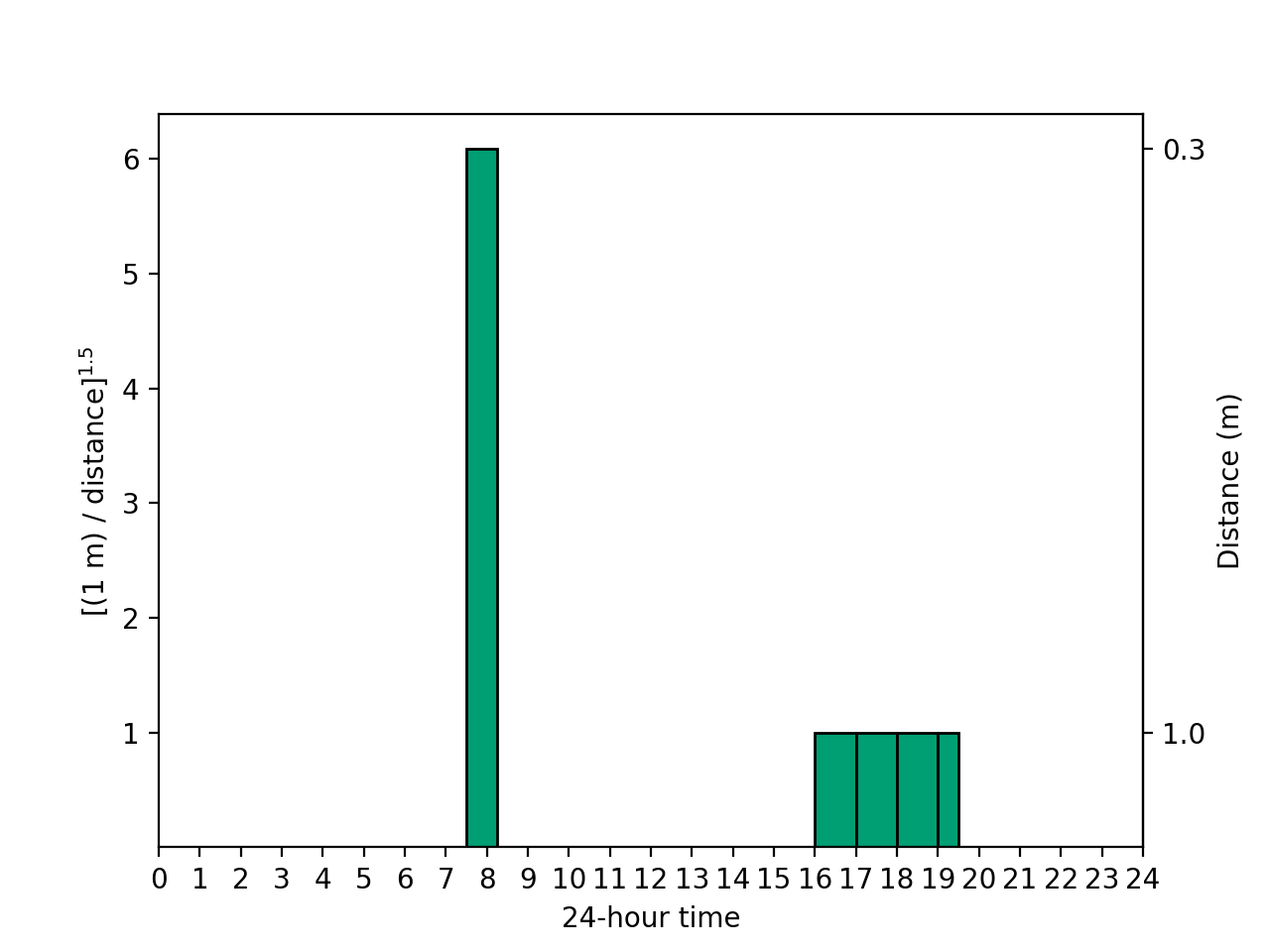
Create a onceoff pattern or a diurnal repeating pattern. For example, a diurnal repeating pattern consisting of contact from 7:30 to 8:15 AM at a distance of 0.3 m and 4:00 to 7:30 PM at 1 m can be created as follows:
from glowgreen import ContactPatternRepeating

theta = [7.5, 16]  # Start times (h) of pattern elements
c = [0.75, 3.5]    # Durations (h) of pattern elements
d = [0.3, 1]       # Distances (m) of pattern elements
cpat = ContactPatternRepeating(theta, c, d)
Note
For repeating patterns, theta is defined with respect to midnight by default.
Conversely, for onceoff patterns ContactPatternOnceoff, theta is defined with respect to the end of the delay period.
Generate a plot of the pattern with:
cpat.plot()
Define a dose rate clearance function
Supply an exponential or biexponential model of the dose rate at some distance (between 1 and 3 m) from the radioactive person as a function of the time from administration of the radioactive substance. For example:
from glowgreen import Clearance_1m

dose_rate_init_2m = 60  # uSv/h
fraction1 = 0.3         # 0 to 1
half_life1 = 8          # h
half_life2 = 30         # h
distance = 2            # m
cfit = Clearance_1m('biexponential', [dose_rate_init_2m, fraction1, half_life1, half_life2],
            distance)
Values must be given in the units shown.
Note
For exponential models, the model parameter list consists of the initial dose rate at distance and the effective half life, in that order.
Calculate the restriction period
How soon after administration can a person resume this infinitely repeating contact pattern with the radioactive person, without their lifetime dose exceeding a given dose constraint?
from datetime import datetime, timedelta

dose_constraint = 1  # mSv
admin_datetime = datetime(day=25, month=12, year=2021, hour=10, minute=30)
restriction_period, dose, datetime_end = cpat.get_restriction(cfit, dose_constraint,
    admin_datetime)

assert dose <= dose_constraint
assert datetime_end == admin_datetime + timedelta(hours=restriction_period)
Printing the results:
>>> restriction_period
29.5
>>> dose
0.9399700449166117
>>> datetime_end
2021-12-26 16:00:00
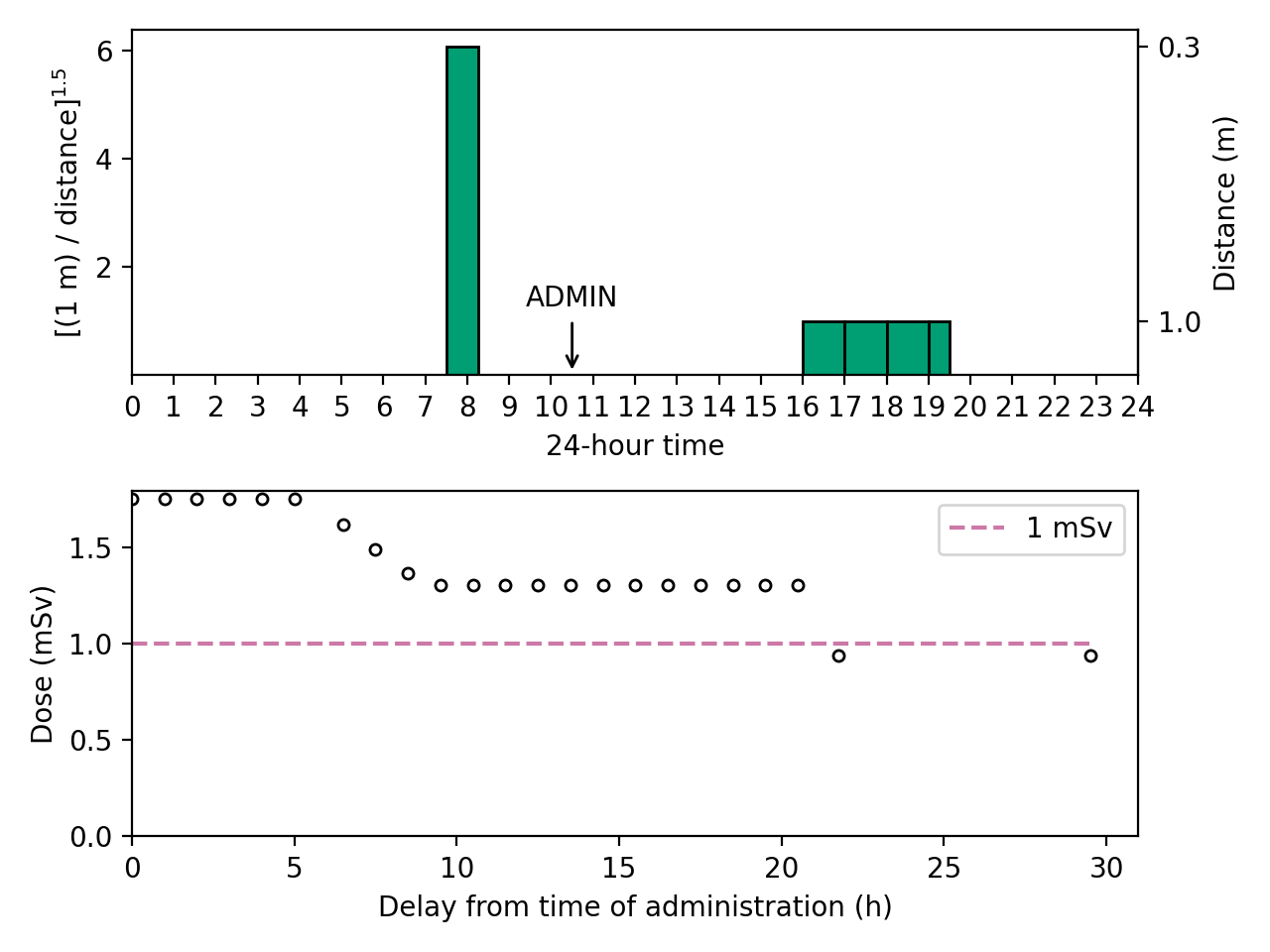
In this case, the restriction period is 29.5 h for a lifetime dose of 0.94 mSv. The pattern can resume the next day starting with the contact from 4:00 to 7:30 PM.
Generate a plot of the lifetime dose as a function of the delay period by supplying additional arguments to the plot method:
cpat.plot(cfit=cfit, dose_constraint=dose_constraint, admin_datetime=admin_datetime)
Note
For repeating patterns, the end of the calculated restriction period coincides with the start of a pattern element by default, so it is clear that contact can resume at the end of the restriction period.
Standard contact patterns
Restriction periods can be calculated for a collection of “real-world” contact patterns (modified from Cormack & Shearer), along with appropriate dose constraints, using:
from glowgreen import cs_restrictions

num_treatments_in_year = 2
df = cs_restrictions(cfit, num_treatments_in_year, admin_datetime)
Then we have:
>>> import pandas as pd
>>> with pd.option_context('display.max_colwidth', None):
...     df[['name', 'datetime_end']]
...
                                                                            name               datetime_end
0                                                     Caring for infants (normal) 2021-12-29 16:00:00.000000
1                                          Caring for infants (demanding or sick) 2021-12-31 07:00:00.000000
2                     Prolonged close contact (>15min) with 2-5 year old children 2021-12-30 06:00:00.000000
3                    Prolonged close contact (>15min) with 5-15 year old children 2021-12-29 06:00:00.000000
4                       Sleeping with another person (includes pregnant or child) 2021-12-31 03:00:00.000000
5                                                Sleeping with informed supporter 2021-12-27 02:00:00.000000
6               Sleeping with person and prolonged daytime close contact (>15min) 2021-12-31 12:00:00.000000
7   Sleeping with informed supporter and prolonged daytime close contact (>15min) 2021-12-27 06:00:00.000000
8                   Prolonged close contact (>15min) with adult household members 2021-12-29 12:00:00.000000
9                Prolonged close contact (>15min) with pregnant household members 2021-12-29 12:00:00.000000
10      Prolonged close contact (>15min) with informed persons caring for patient 2021-12-25 11:00:00.000000
11                                Cinema, theatre visits; social functions/visits 2021-12-28 09:00:00.000000
12                                        Daily public transport to and from work 2021-12-28 17:00:00.000000
13          Return to work involving prolonged close contact (>15min) with others 2021-12-29 09:00:00.000000
14      Return to work not involving prolonged close contact (>15min) with others 2021-12-27 15:00:00.000000
15                                             Work with radiosensitive materials 2021-12-31 16:00:00.000000
16                                                               Return to school 2021-12-29 09:00:00.000000
17                                      A single 24-hour trip on public transport 2021-12-31 08:33:45.528190
See API reference for additional package features and more detailed information.
Development
Publications
Papers that use glowgreen:
Forster JC et al. “Close contact restriction periods for patients who have received iodine-131 therapy for differentiated thyroid cancer.” J Radiol Prot. 2023;43(2):021501. doi: 10.1088/1361-6498/acc4d0.